
A painting can look generous on a product page and surprisingly small above your couch. The easiest way to avoid that mismatch is to size the art from the sofa first, then check the result against the clear wall around it.
As a practical starting point, choose a painting or artwork group that is about 66% to 75% of the sofa’s width. Measure from the outside of one sofa arm to the outside of the other. Then test the full artwork outline on your wall before you buy.
This guide shows you how to calculate the width, set a sensible hanging height, compare a single painting with grouped art, and check the details that measurements alone cannot settle.
The Quick Answer: Start with the Sofa, Not the Entire Wall
For art placed directly above a sofa, use this calculation:
Sofa width x 0.66 to 0.75 = starting artwork width range
If your sofa is 84 inches wide, the calculation gives you a target width of about 56 to 63 inches. That measurement can describe one painting, a pair, a triptych, or a gallery wall. For grouped art, it must include every gap between the pieces.
The ratio is a styling guide, not a fixed law. Your ceiling height, sofa back, frame, wall features, and the visual weight of the art can all change what looks right. Use the calculation to narrow your options, then confirm the size with painter’s tape or paper templates.
Painting Size Chart by Sofa Width
The figures below are rounded to the nearest whole inch and centimeter.
| Sofa width | Starting artwork width | Approximate metric width |
|---|---|---|
| 60 inches | 40 to 45 inches | 102 to 114 cm |
| 72 inches | 48 to 54 inches | 122 to 137 cm |
| 84 inches | 56 to 63 inches | 142 to 160 cm |
| 90 inches | 59 to 68 inches | 150 to 173 cm |
| 96 inches | 63 to 72 inches | 160 to 183 cm |
| 108 inches | 71 to 81 inches | 180 to 206 cm |
Use the table as a shopping range, not a command to order the nearest listed size. If two available sizes fall on either side of your range, tape both outlines on the wall and compare them from the places where you normally sit and enter the room.
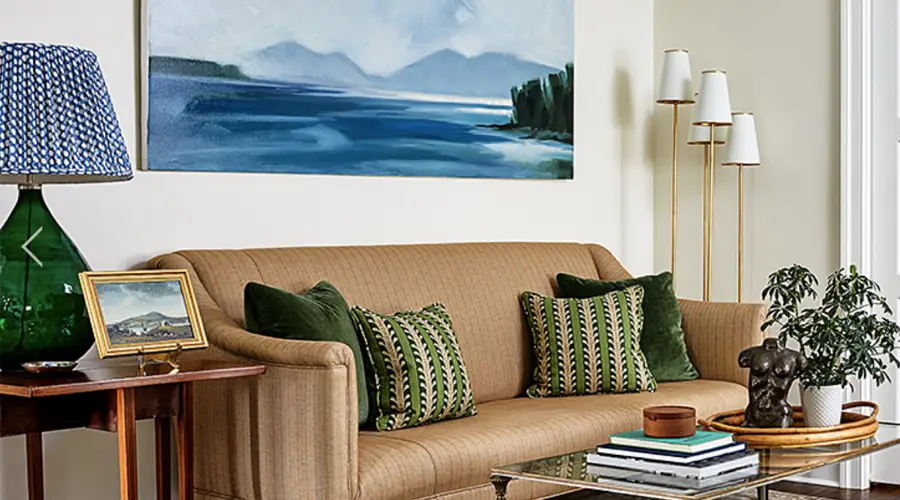
How to Measure the Sofa and Available Wall Space
You need more than one wall measurement. Record the sofa, the clear wall zone, and the finished artwork size as separate figures.
1. Measure the sofa from arm to arm
Measure across the widest visible part of the sofa, from the outside edge of one arm to the outside edge of the other. Do not use seat count as your main measurement. Two three-seat sofas can have very different widths.
Also record the height of the sofa back. You will need it when you decide how high to place the art.
For a sectional, measure the main section and wall zone where the art will be centered. Using the full length of an L-shaped sectional can produce a width that does not suit the wall behind the main seating section.
2. Measure the clear wall zone
Measure the wall area that the art can actually use. Mark anything that breaks up that space, such as:
- Windows and doors
- Wall moulding
- Shelves and sconces
- Switches, outlets, and vents
- Floor lamps and tall side tables
- A nearby television or cabinet
The sofa usually sets the first width target, but the clear wall tells you whether that target can work without crowding nearby features.
3. Check what the listed artwork dimensions include
A product page may list the image size, canvas size, framed size, or another measurement. For this calculation, you need the complete displayed width.
If a 48-inch canvas gains several inches from its outer frame, use the framed width. For a multi-piece layout, add every panel and every gap. Depth matters too when the piece sits near a door swing, curtain, shelf, or narrow walkway.
How Wide Should a Painting Be Above a Sofa?
The 66% to 75% range gives the artwork enough width to relate to the sofa while usually leaving visible space at both sides. It also keeps the sofa as the main horizontal anchor.
Here is how the range works in practice:
- Near 66%: A quieter starting point that leaves more open wall at the sides.
- Near 75%: A fuller look with more visual presence.
- Below the range: This can still work, but one small piece may look detached unless it has a strong frame or joins a group.
- Above the range: This may suit a deliberate full-wall arrangement, but it needs a careful mock-up so the art does not crowd the sofa.
Do not rely on width alone. A dark, textured, or heavily framed painting may feel larger than a pale, open composition with the same outer dimensions. There is no reliable number that corrects for those visual differences. A full-size wall preview is the better test.
Should the painting be centered over the sofa or the wall?
Center it over the sofa when the sofa is the clear anchor for that part of the room. This keeps the two pieces visually connected, even if the sofa is not centered on the full wall.
If the wall includes a fireplace, built-in cabinet, window, or another strong feature, the best center may be less obvious. Tape the artwork outline in more than one position and judge the whole seating area, not just the empty wall.
How High Should You Hang Art Above a Sofa?
Start with 6 to 10 inches between the top of the sofa back and the bottom of the displayed artwork. This range usually keeps the art close enough to read with the sofa instead of floating above it.
Some styling guidance uses a tighter 3 to 6 inch gap. That difference is a good reminder that hanging ranges are visual conventions. The right gap depends on the sofa back, artwork height, ceiling, and normal viewing position.
Use these checks before marking the hardware position:
- Keep enough clearance for cushions and anyone sitting on the sofa.
- Check the artwork from a seated position as well as from across the room.
- If the sofa has a tall back, test the lower end of the gap range first.
- If the sofa is low, a little more space may look comfortable, provided the art still feels connected to it.
- Do not raise the painting simply because the ceiling is high.
A center point around 57 to 60 inches from the floor is often used for art on an open wall. Above a sofa, treat that figure as a secondary check. The relationship to the furniture usually matters more than a fixed centerline.
Visual placement and physical safety are separate decisions. The correct-looking position does not tell you which hardware the wall can support. Check the artwork’s assembled weight, the wall construction, and the hardware instructions before installation.
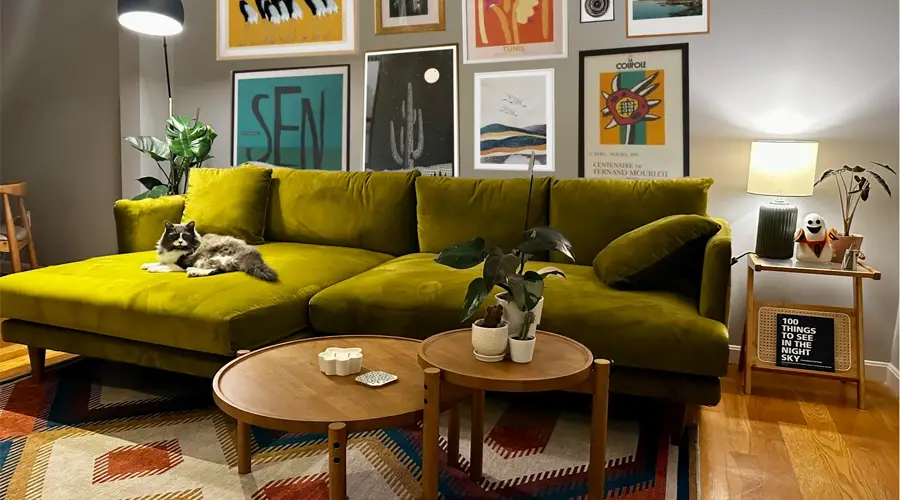
One Large Painting, a Pair, a Triptych, or a Gallery Wall?
The same width calculation works for each format. What changes is how you add up the pieces and gaps.
One large painting
Choose one large piece when you want a simple focal point and an easy-to-read outline. A single painting also makes the tape test straightforward because you only need its finished outer width and height.
The tradeoff is access and installation. A wide fixed frame may be harder to carry through a doorway, hallway, staircase, or elevator. Check the packaged dimensions as well as the displayed dimensions.
A pair or triptych
A pair can suit a balanced layout, while a triptych can spread one composition or a related set across the available width. Count the gaps as part of the finished arrangement.
For three 18-inch panels with two 2-inch gaps, the total is:
18 + 2 + 18 + 2 + 18 = 58 inches
A triptych often works with gaps of about 2 to 4 inches. Smaller panels usually read as one group with tighter gaps. Larger panels can accept a little more space.
A gallery wall
A gallery wall gives you more freedom to combine sizes and work around wall features. Treat the outside edges of the full arrangement as one rectangle when you compare it with the sofa.
For a compact group, start with 2 to 3 inches between neighboring frames. Keep the spacing consistent. Wider gaps can create a more open look, but they also make it harder for the pieces to read as one composition.
Lay the pieces on the floor first, then make exact paper templates for the wall. Marking the hardware location on each template can also help you see whether the proposed layout and mounting points agree.
Adjust the Size for Ceiling Height and Room Layout
The sofa sets a useful horizontal target, but it does not settle the artwork’s height or orientation.
Low or standard ceilings
A horizontal painting often works naturally above a long sofa because the shapes share a similar direction. With a low ceiling, watch the space above the painting. A tall piece can feel crowded if its upper edge sits too close to the ceiling.
Keep the artwork tied to the sofa and use the wall template to test both the lower gap and the remaining open space above it.
Tall ceilings
A high wall may need more artwork height, not simply more width. A taller painting, a stacked pair, or a multi-row arrangement can use the vertical area while the total width still relates to the sofa.
Resist the urge to move the whole piece far above the furniture. If the gap becomes too large, the painting and sofa may stop reading as one arrangement.
Open-plan or interrupted walls
Windows, sconces, built-ins, and doorways can make a calculated width awkward. In that setting, a pair or grouped layout may fit the usable sections better than one fixed frame.
Orientation can help too. A wide piece follows a long sofa, while a taller format can use a narrow wall bay. These are visual choices, so test the outer footprint rather than treating orientation as another fixed rule.
Common Sizing Mistakes to Avoid
Most scale problems begin before the art reaches the wall. Watch for these errors while shopping:
Measuring only the wall
The wall may be much wider than the sofa. If the painting belongs to the seating area, begin with the sofa and use the wall as the boundary check.
Forgetting the frame
The outer frame changes both width and height. Ask for the finished dimensions if the listing only shows the canvas or image size.
Ignoring gaps in grouped art
Three panels are not just three panel widths. Add the spaces between them to get the true displayed span.
Hanging the art too high
A large gap can make a correctly sized painting look unrelated to the sofa. Tape the bottom edge 6 to 10 inches above the sofa as a first test, then adjust it in the room.
Trusting styled photography alone
Product photos can hide scale differences. Camera angle, furniture size, cropping, and room styling can all change how large a piece appears. Compare stated measurements, not visual impressions alone.
Skipping access and mounting checks
A painting can fit the wall and still be difficult to deliver or install. Check the total assembled weight, packaged size, frame depth, wall type, supplied hardware, and access route. Ask the seller or a qualified installer when those details are unclear.
Pre-Purchase Measuring Checklist
Before you order, work through this list:
- [ ] Measure the sofa from outside arm to outside arm.
- [ ] Record the sofa-back height.
- [ ] Measure the clear wall width and height.
- [ ] Mark nearby windows, shelves, lamps, switches, vents, and screens.
- [ ] Multiply the sofa width by 0.66 and 0.75.
- [ ] Confirm the complete framed or displayed dimensions.
- [ ] Add all panel widths and gaps for grouped art.
- [ ] Tape the exact outer width and height on the wall.
- [ ] View the outline from the sofa, the room entrance, and across the room.
- [ ] Check it in normal daylight and evening lighting.
- [ ] Compare the packaged size with doors, halls, stairs, and elevators.
- [ ] Check assembled weight, wall construction, and mounting instructions.
- [ ] Read the seller’s delivery, damage-reporting, return, and warranty terms.
Take a photo of the taped outline from your usual viewing position. A phone photo can make an undersized or overly tall arrangement easier to spot. If you are comparing two sizes, photograph both outlines under the same lighting.
Frequently Asked Questions
What size painting should go above an 84-inch sofa?
Start with a total artwork width of about 56 to 63 inches. That can be one framed painting or the full span of a group, including the gaps. Tape the exact available sizes on your wall before choosing.
Can a painting be wider than the sofa?
It can, but that is usually a deliberate full-wall choice rather than the safest starting point. Mock up the full outline and check nearby furniture, wall features, and open space before using art that extends beyond the sofa.
How high should a painting hang above a couch?
Start with the bottom of the artwork 6 to 10 inches above the sofa back. Then check the piece from a seated position and across the room. Sofa height, artwork height, and ceiling space may call for an adjustment.
Does the frame count when measuring wall art?
Yes. Use the full outside dimensions of the displayed piece. If you are buying an unframed canvas and plan to add a frame later, get the expected framed dimensions before making the final size decision.
How do I measure a triptych above a sofa?
Add the width of all three panels and both gaps. Three 18-inch panels with two 2-inch gaps have a total displayed width of 58 inches. Compare that total with 66% to 75% of the sofa width.
Should art be centered over the sofa or the wall?
Center it over the sofa when the seating area is the main visual unit. If built-ins, windows, or other fixed features compete for attention, test the artwork outline in relation to the full arrangement before choosing the center.
Measure, Calculate, Then Test the Real Size
To choose what size painting goes above a sofa, begin with the sofa’s arm-to-arm width. Calculate 66% to 75%, confirm the complete displayed dimensions, and tape that footprint on the wall.
Then check the parts the formula cannot judge: the frame, artwork height, ceiling space, grouped-art gaps, viewing position, mounting needs, and delivery route. A few careful measurements before purchase give you a much clearer choice than a product photo alone.